BDA3 Chapter 3 Exercise 2
Here’s my solution to exercise 2, chapter 3, of Gelman’s Bayesian Data Analysis (BDA), 3rd edition. There are solutions to some of the exercises on the book’s webpage.
| survey | bush | dukakis | other | total |
|---|---|---|---|---|
| pre-debate | 294 | 307 | 38 | 639 |
| post-debate | 288 | 332 | 19 | 639 |
Let \(\theta_\text{pre} \sim \ddirichlet_3(\alpha_\text{pre})\) and \(\theta_\text{post} \sim \ddirichlet_3(\alpha_\text{post})\) be the pre- and post-debate priors. Then the posteriors are
\[ \begin{align} \theta_\text{pre} \mid y &\sim \ddirichlet\left(294 + \alpha_{(\text{pre}, \text{b})}, 307 + \alpha_{(\text{pre}, \text{d})}, 38 + \alpha_{(\text{pre}, \text{o})} \right) \\ \theta_\text{post} \mid y &\sim \ddirichlet\left(288 + \alpha_{(\text{post}, \text{b})}, 332 + \alpha_{(\text{post}, \text{d})}, 19 + \alpha_{(\text{post}, \text{o})} \right) . \end{align} \]
Denote the proportion of support for Bush amongst Bush/Dukakis supporters by \(\phi_\bullet := \frac{\theta_{(\bullet, \text{b})}}{\theta_{(\bullet, \text{b})} + \theta_{(\bullet, \text{d})}}\). The results of the previous exercise show that we can treat this as a beta-binomial problem by simply ignoring the results for other. More precisely,
\[ \begin{align} \phi_\text{pre} \mid y &\sim \dbeta\left(294 + \alpha_{(\text{pre}, \text{b})}, 307 + \alpha_{(\text{pre}, \text{d})} \right) \\ \phi_\text{post} \mid y &\sim \dbeta\left(288 + \alpha_{(\text{post}, \text{b})}, 332 + \alpha_{(\text{post}, \text{d})} \right) \end{align} . \]
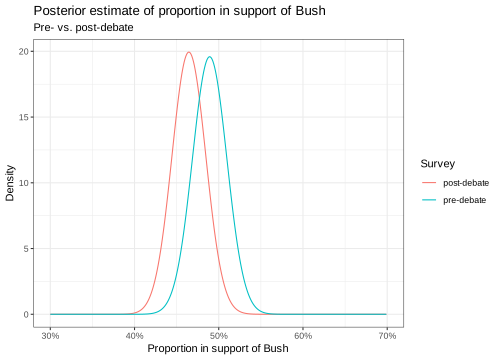
Let’s plot these posteriors and their difference \(\delta := (\phi_\text{post} \mid y) - (\phi_\text{pre} \mid y)\).
alpha_bush <- 1
alpha_dukakis <- 1

posteriors <- expand.grid(
    value = seq(0, 1, 0.001),
    survey = df$survey
  ) %>%
  as_tibble() %>%
  inner_join(df, by = 'survey') %>%
  mutate(
    post_bush = bush + alpha_bush,
    post_dukakis = dukakis + alpha_dukakis,
    density = dbeta(value, post_bush, post_dukakis)
) 
N <- 10000

shift <- expand.grid(
    draw = 1:N,
    survey = df$survey
  ) %>%
  as_tibble() %>%
  inner_join(df, by = 'survey') %>%
  mutate(
    post_bush = bush + alpha_bush,
    post_dukakis = dukakis + alpha_dukakis,
    value = rbeta(n(), post_bush, post_dukakis)
  ) %>%
  select(draw, survey, value) %>%
  spread(survey, value) %>%
mutate(difference = `post-debate` - `pre-debate`) 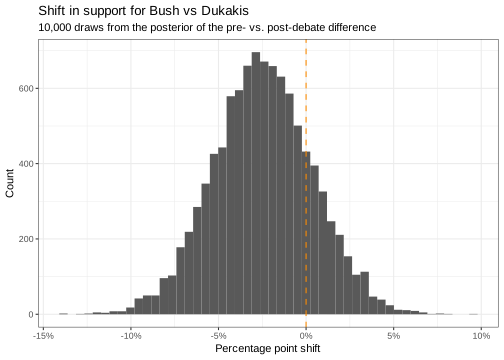
There is a 19% probability (the area above 0) that there was a positive shift towards Bush.