BDA3 Chapter 2 Exercise 1
Here’s my solution to exercise 1, chapter 2, of Gelman’s Bayesian Data Analysis (BDA), 3rd edition. There are solutions to some of the exercises on the book’s webpage.
Let \(H\) be the number of heads in 10 tosses of the coin. With a \(\dbeta(4, 4)\) prior on the probability \(\theta\) of a head, the posterior after finding out \(H \le 2\) is
\[ \begin{align} p(\theta \mid H \le 2) &\propto p(H \le 2 \mid \theta) \cdot p(\theta) \\ &= \dbeta(\theta \mid 4, 4) \sum_{h = 0}^2 \dbinomial(h \mid \theta, 10) \\ &= \theta^3 (1 - \theta)^3 \sum_{h = 0}^2 \binom{10}{h} \theta^h (1 - \theta)^{10 - h}. \end{align} \]
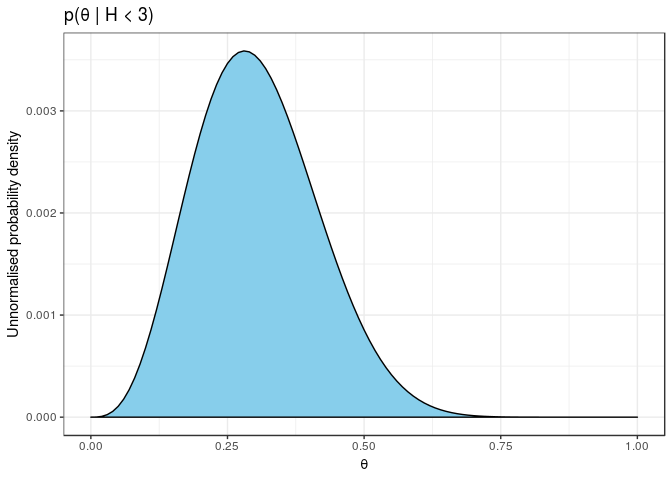
We can plot this unnormalised posterior density from the following dataset.
ex1 <- tibble(
         theta = seq(0, 1, 0.01),
         prior = theta^3 * (1 - theta)^3,
         posterior = prior * (
           choose(10, 0) * theta^0 * (1 - theta)^10 +
           choose(10, 1) * theta^1 * (1 - theta)^9 +
           choose(10, 2) * theta^2 * (1 - theta)^8
         )
       )
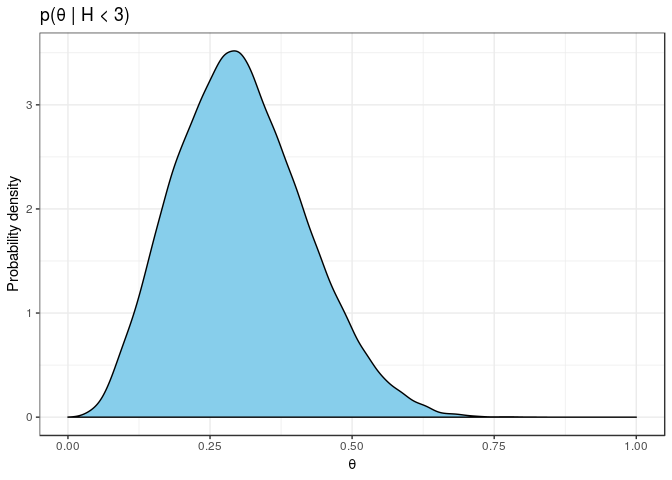
With the help of Stan, we can obtain the normalised posterior density. We include the information that there are at most 2 heads observed by using the (log) cumulative density function.
m1 <- rstan::stan_model('src/ex_02_01.stan')S4 class stanmodel 'ex_02_01' coded as follows:
transformed data {
int tosses = 10;
int max_heads = 2;
}
parameters {
real<lower = 0, upper = 1> theta;
}
model {
theta ~ beta(4, 4); // prior
target += binomial_lcdf(max_heads | tosses, theta); // likelihood
} The following posterior has the same shape as our exact unnormalised density above. The difference is that we now have a normalised probability distribution without having to work out the maths ourselves.
f1 <- sampling(m1, iter = 40000, warmup = 500, chains = 1)